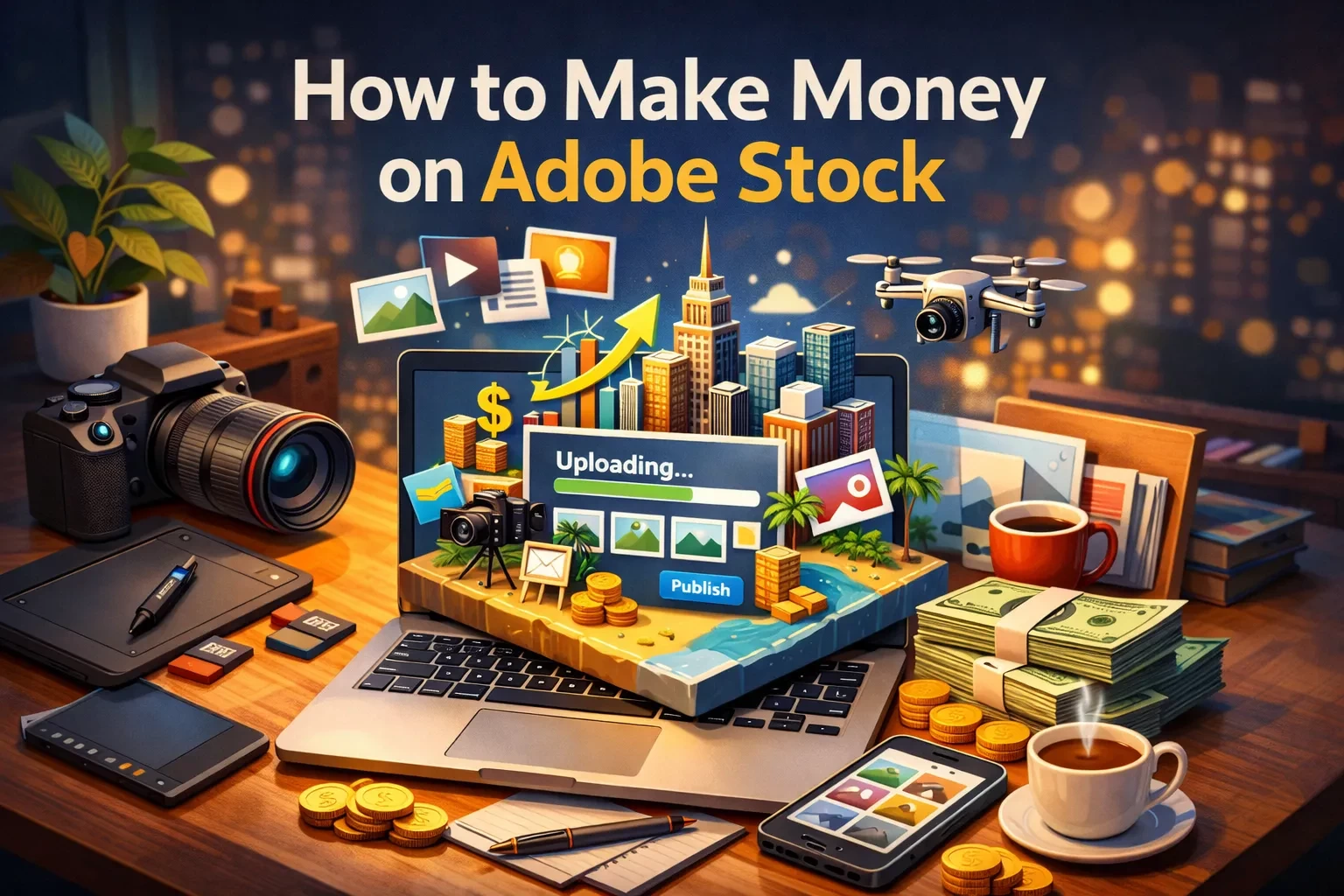








Quick answer: You can make money on Adobe Stock by uploading high-quality, legally compliant images (including AI-generated content) and earning royalties each time your work is licensed. Contributors typically receive 33% of the net price for images and 35% for video. Sustainable income comes from consistency, strong metadata, and strict compliance—not shortcuts.
Disclosure: If you promote your Adobe Stock portfolio using affiliate links, disclose that relationship clearly and conspicuously in accordance with FTC guidelines.
Table of Contents
◉ Why this matters now ◉ Key definitions (plain English) ◉ Step-by-step: Getting started ◉ How royalties actually work ◉ Pros, cons, and risks ◉ Repeatable workflow ◉ Common mistakes ◉ FAQ ◉ Next steps
Why this matters now
Demand for stock content has evolved rapidly. Businesses now need fast, scalable, and trustworthy visual assets for ads, websites, and social media. At the same time, buyers are more concerned about authenticity and usage rights—especially with the rise of AI-generated content.
Adobe Stock has responded by maintaining a transparent royalty structure and introducing tools like Content Credentials, which help verify how content was created. For contributors, this creates an opportunity to build a legitimate, scalable digital asset business—provided you understand licensing, compliance, and market demand.
Key definitions (plain English)
Adobe Stock: A marketplace where creatives upload content that customers license for commercial use.
Royalty: Your percentage of the net price paid by the buyer (33% images, 35% video).
Model Release: Legal permission from a recognizable person allowing commercial use of their likeness.
Property Release: Permission to use private or protected property in commercial content.
Generative AI Content: Images or videos created using AI tools. Must be labeled accurately and comply with platform rules.
Content Credentials: Metadata that shows authorship and creation method, increasing buyer trust.
Step-by-step: Getting started
1) Create your contributor account
Register with Adobe, verify your identity, and accept the contributor agreement. You must be at least 18 years old.
2) Set up payments and tax information
Choose a payout method such as PayPal, Payoneer, or Skrill, and complete the correct tax documentation. Keeping this information accurate helps avoid payment delays and unnecessary withholding.
3) Plan content strategically
Focus on commercially useful themes such as business, education, wellness, technology, family life, or small business. Think about what marketers, publishers, and brands actually need.
4) Create content for licensing
Stock content should be technically clean, legally safe, and broadly useful. Watch for noise, soft focus, visible trademarks, copyrighted artwork, and restricted subjects.
5) Organize releases and supporting files
If your image includes a recognizable person or protected property, keep the required releases organized and easy to match with each submission.
6) Upload with accurate metadata
Write descriptive titles and helpful keywords based on real buyer intent. Metadata affects discoverability almost as much as image quality.
7) Learn from results
Review what gets accepted, what gets rejected, and what actually sells. Over time, this feedback loop is what improves your portfolio performance.
How royalties actually work
Adobe Stock pays contributors a percentage of the net amount received from each license.
Images, illustrations, and vectors: typically 33% of the net price.
Video: typically 35% of the net price.
Simple example:
If a customer licenses an image through a subscription plan, your royalty may be modest on that individual sale. If your portfolio contains many relevant files, those small royalties can compound over time.
Important takeaway: Stock income is usually built through portfolio depth, commercial relevance, and consistency rather than one high-paying image.
Pros, cons, and risks
Advantages
- Scalable digital asset model
- Access to a global marketplace
- Clear royalty structure
- Potential for recurring income from older assets
Challenges
- Strong competition in popular categories
- No direct control over pricing
- Strict content and legal compliance requirements
- Variable earnings from month to month
Risk management
- Use model and property releases whenever needed
- Avoid logos, trademarks, and copyrighted elements
- Label AI-generated content accurately
- Keep organized payout and tax records
Repeatable workflow
Research demand → Plan the shoot → Capture the content → Edit carefully → Review compliance → Upload → Add metadata → Submit → Track results → Repeat
This kind of repeatable workflow is what turns occasional uploads into a disciplined portfolio strategy.
Common mistakes
1) Weak keywords
Using broad terms like “business” or “lifestyle” without enough specificity can hurt discoverability.
2) Overlooking legal issues
A good image can still be rejected if it includes visible branding, copyrighted artwork, or missing releases.
3) Editing for social media instead of stock
Heavy filters, oversaturation, artificial sharpening, or extreme grading often reduce stock usability.
4) Mislabeling AI content
Transparency matters. Inaccurate labeling can create trust issues and violate submission policies.
FAQ
Next steps
Start by choosing one or two commercially relevant themes and building a small but strong first portfolio. Prioritize technical quality, accurate metadata, and full compliance. Then publish consistently, review your results, and scale the concepts that perform best.
Risk disclaimer: Adobe Stock income is not guaranteed. Results vary based on portfolio quality, subject demand, approval rates, and market competition. Treat it as a long-term content business, not a guaranteed shortcut to income.